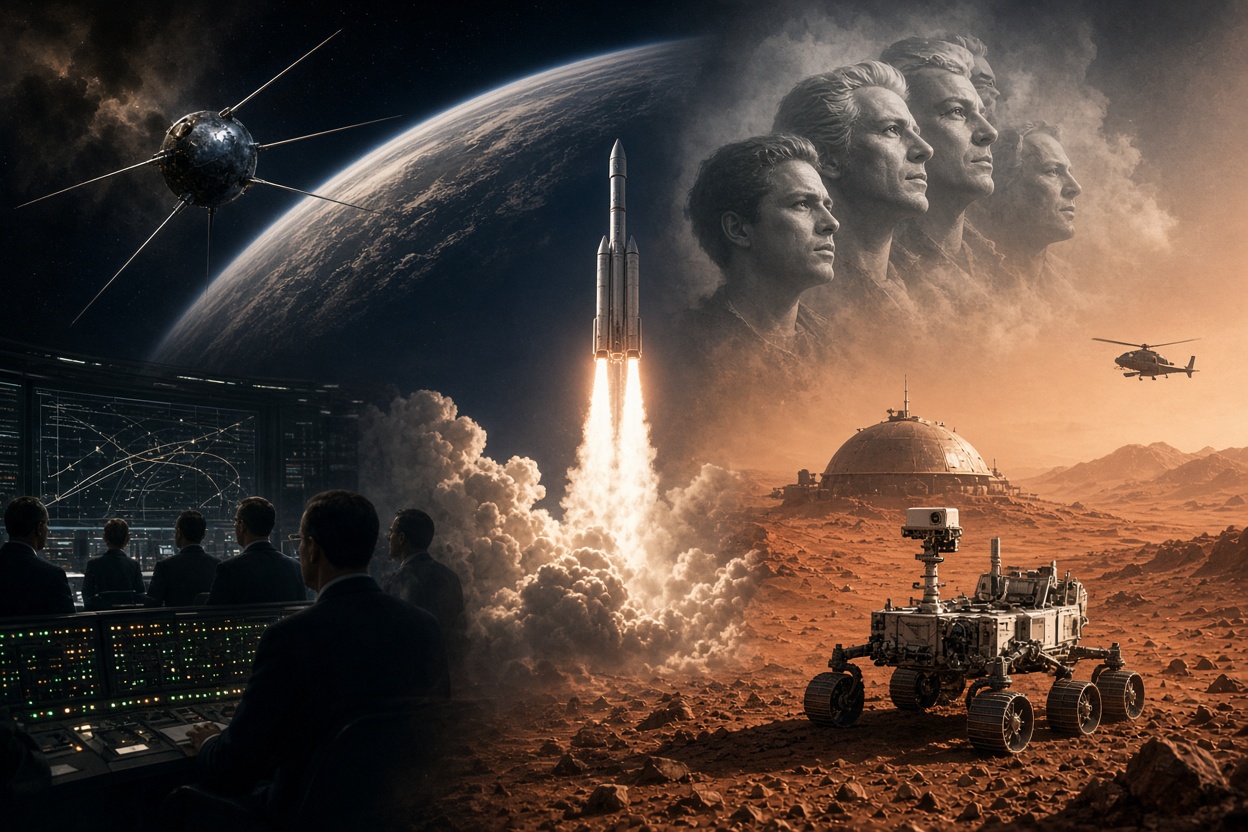
In the wake of the Soviet Union's Sputnik launch in 1957, the United States faced an existential technological humiliation that demanded immediate structural reform. President Eisenhower's administration responded by creating the National Aeronautics and Space Administration on July 29, 1958, consolidating fragmented military and civilian aerospace efforts into a single civilian agency. This foundational decision centralized research, engineering, and mission planning under one roof, setting the stage for an unprecedented era of American space dominance. Early leaders like T. Keith Glennan navigated intense political pressures while recruiting talent from universities and industry, establishing NASA's decentralized center model that persists today across ten major facilities.
The agency's first decade tested its organizational resilience through the Mercury and Gemini programs, where rapid iteration under Wernher von Braun's rocket teams produced the Saturn V launcher. These missions revealed critical turning points: the Apollo 1 fire in 1967 exposed safety lapses that forced rigorous redesigns and cultural shifts toward zero-defect engineering. By Apollo 11's success in 1969, NASA had evolved into a mission-driven bureaucracy balancing political mandates with scientific priorities, a tension that continues to define its structure amid shifting administrations and budgets.
The Shuttle Era: Ambition Meets Organizational Strain
The Space Shuttle program, approved in 1972, represented NASA's pivot toward reusable systems and routine access to orbit. Engineers like Maxime Faget championed the orbiter design while administrators negotiated with Congress for funding. However, the 1986 Challenger disaster exposed deep flaws in decision-making processes, where schedule pressures overrode safety warnings from engineers. The subsequent Rogers Commission investigation prompted sweeping organizational reforms, including independent safety offices and enhanced contractor oversight. These changes influenced the International Space Station assembly, demonstrating how tragedy catalyzed structural improvements that extended NASA's operational lifespan.
Hubble and the Power of Adaptive Missions
Launched in 1990 with a flawed mirror, the Hubble Space Telescope became a defining case study in NASA's problem-solving culture. Project scientist Robert O'Dell and subsequent teams orchestrated five servicing missions, transforming an initial failure into one of astronomy's greatest instruments. These repairs highlighted the agency's ability to integrate human spaceflight with robotic science, a dual capability rooted in its hybrid organizational DNA. Hubble's discoveries reshaped cosmological understanding while reinforcing NASA's commitment to long-term mission adaptability despite budgetary constraints.
Mars Exploration: From Rovers to Sample Return
NASA's Mars program evolved through iterative missions led by figures like Jet Propulsion Laboratory director Charles Elachi. The 1997 Pathfinder landing validated airbag technology, paving the way for Spirit and Opportunity's extended operations. The 2012 Curiosity rover introduced nuclear-powered mobility, while Perseverance's 2021 arrival initiated the Mars Sample Return campaign in partnership with ESA. Each success built on prior failures like the 1999 Mars Climate Orbiter loss, which prompted standardized metric protocols. These turning points underscore NASA's shift toward sustainable exploration architectures.
Artemis and Commercial Partnerships: A New Organizational Model
Under Administrator Jim Bridenstine and successor Bill Nelson, NASA embraced public-private partnerships through the Commercial Crew Program. SpaceX's Crew Dragon flights marked a pivotal decentralization, reducing reliance on Russian Soyuz while fostering innovation. The Artemis program, targeting sustainable lunar presence by 2025, integrates SLS rocket development with private landers from Blue Origin and others. This hybrid model reflects broader consequences of budget realities, distributing risk across industry while preserving NASA's core role in deep-space architecture and scientific prioritization.
Climate Science and Earth Observation Legacy
Beyond deep space, NASA's Earth science division has delivered critical data on climate change through missions like Landsat and GRACE. Initiated in the 1970s, these programs evolved under administrators who balanced planetary exploration with terrestrial monitoring. Decisions to maintain long-term datasets enabled breakthroughs in ice sheet tracking and atmospheric analysis, influencing global policy. The agency's organizational breadth across Goddard and Langley centers facilitated interdisciplinary collaboration that continues to yield high-impact environmental intelligence.
NASA's greatest strength lies not in any single rocket or telescope, but in its enduring capacity to learn from failure and adapt its mission to the needs of each generation.
As NASA advances toward crewed Mars missions and exoplanet characterization, its organizational evolution offers lessons in resilience, innovation, and public stewardship. From Sputnik's catalyst to Artemis's ambitions, the agency has repeatedly transformed crises into capabilities, ensuring humanity's continued expansion into the cosmos while delivering tangible benefits on Earth. Its future hinges on sustaining this adaptive spirit amid evolving global competition and technological frontiers.




Comments
Sign in to comment, like and save posts.
Sign inLoading comments…